8.29K+ Clicks & 354K Impressions! A Practical 28-Day Organic Search Growth Case Study
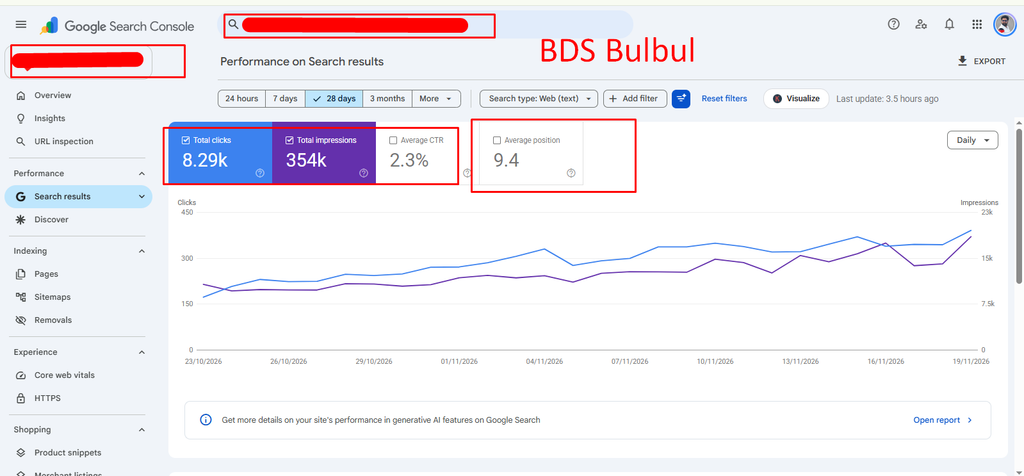
Get Straight to the Point: Combining intent-aligned keywords, clean technical site hygiene, and AI-ready content structure generated 8.29K organic clicks and 354K impressions over a 28-day window. Neither human readers nor modern search engines want drawn-out filler at the top of a page. Our latest Google Search Console (23/10/2026 – 19/11/2026) performance snapshot shows upward momentum across both clicks and impressions alongside a 2.3% CTR and 9.4 average position. Verified Performance Summary (Last 28 Days) Key metrics from the 28-day Google Search Console report: Performance Metric Verified Result (Last 28 Days) Practical Impact Total Organic Clicks 8.29k Steady organic visits and buyer clicks to the site Total Impressions 354k Broad search visibility across targeted queries Average CTR 2.3% Clear click appeal from titles and snippets Average Position 9.4 Consistent upward trend near top search rankings The 4 Core Principles Behind This Execution: 1. Direct Answers First (AEO Strategy) Lead key sections with direct, clear answers in the opening lines so readers and AI-driven search features can extract value right away. 2. Real Experience & Trust Signals (E-E-A-T) Ground pages in practical experience, accurate metrics, and clear structure to reinforce credibility and user trust. 3. Scannable Tables & Visual Structure Use structured tables, clear subheadings, and concise points instead of heavy walls of text to keep readers engaged. 4. Owned Audience Channels Beyond Search Build owned touchpoints—such as email newsletters and direct inquiry channels—so your audience isn’t tied solely to search shifts. Next Steps for Your Business Is your website struggling to turn search visibility into steady traffic and leads? A structured SEO and content framework helps brands compete sustainably as search evolves. 👉 I am BDS Bulbul Ahmed (Senior SEO Consultant), ready to help scale your organic search growth. Claim Your FREE SEO Growth Audit! Send us your website URL today to get a Free Audit & Growth Roadmap highlighting key ranking and traffic opportunities.
The Future of SEO: Who Will Survive the AI Search Era, and Who Won’t
By BDS Bulbul Ahmed |BDS Digital Marketing agency | November 20, 2026 Just a few years ago, SEO was simple math. Get onto Google’s first page, and visitors would come. Visitors meant revenue. By 2026, that equation has changed. Google now often answers the question itself, and users leave without ever visiting a website. Many people skip Google entirely and ask ChatGPT or Gemini instead. So is SEO dying? The short answer is no. But SEO is changing, and those who fail to understand that change are the ones who will disappear. Let’s look at the data: what has changed, and what is coming next. At a Glance: The Reality of Search in 2026 Metric Latest data Share of searches showing AI Overviews Rose from 15% to 43% in one year (Similarweb) Zero-click searches (US) 68.01% in the first four months of 2026, up from 60.45% in 2024 Click-through rate for the #1 result when an AI Overview appears About 58% lower (Ahrefs) Google AI Mode users More than 1 billion per month ChatGPT users 1.2 billion per week Publishers’ Google search traffic Down by a third globally between November 2024 and November 2025 From 1950 to 2026: How Search Got Here The philosophical roots of today’s AI search go back to 1950. That year, British mathematician Alan Turing asked in his paper “Computing Machinery and Intelligence” whether machines can think. Roughly seven decades later, that same question sits inside our search bar. The SEO journey, in brief: According to Search Engine Journal, AI Overviews are the biggest change to search since featured snippets were introduced in 2014. The Present: What Has Changed 1. Google now gives answers, not just links AI is no longer an optional add-on to search. According to a new report, Google’s AI Overviews went from appearing in 15% of searches to 43% in just one year. The whole search journey is now built around AI: users are shown an AI Overview first and then invited to continue their research in AI Mode. These numbers vary by methodology, however. SparkToro’s research puts AI Overviews on more than 20% of Google searches, and when they appear, click-through rates drop by nearly 60%. Whichever figure you use, the trend points the same way. 2. Clicks are falling, sharply This is the biggest news for publishers. According to new SparkToro research, 68.01% of Google searches in the US ended without a click during the first four months of 2026, up from 60.45% in 2024. Ahrefs’ research is even more direct: the presence of an AI Overview now correlates with a 58% lower average click-through rate for the top-ranking page. Put simply, for every 100 clicks a top-ranking page used to earn, Google now keeps 58. Publisher traffic reflects this. Chartbeat data published in the Reuters Institute’s 2026 trends report showed that Google search traffic to publishers fell by a third globally between November 2024 and November 2025, and by 38% in the United States. Who is most exposed? Experts point to news, affiliate, recipe and how-to publishers, whose traffic depends heavily on informational searches. 3. Search is happening outside Google, too AI chatbots are now serious competitors to search. OpenAI says ChatGPT grew from 1 billion to 1.2 billion weekly active users in just two months, and that its search volume is roughly 20% of Google’s. Read that number with caution, though: the company has not disclosed its methodology or the source of its Google data, so the 20% should not be read as ChatGPT’s share of the search market. Google isn’t standing still either. The company reports that AI Mode has passed 1 billion monthly active users, and AI Overviews reach 2.5 billion people. 4. Bangla has entered AI search This matters for Bangla-language publishers. In India, Google has expanded AI Mode to seven new languages: Bengali, Kannada, Malayalam, Marathi, Tamil, Telugu and Urdu. Google says the expansion runs on a custom Gemini model for Search, built to understand the nuances of local languages rather than simply translating words. How widely Bangla AI Mode is available in Bangladesh still needs to be checked separately. The message is clear, though: Bangla websites are now competing with AI-generated answers as well. What Google Itself Is Saying A whole industry has sprung up selling AI search tactics under names like “AEO” (Answer Engine Optimization) and “GEO” (Generative Engine Optimization). In May 2026, Google addressed this directly by publishing its first official guide to AI search optimization on May 15. The guide includes: What does “non-commodity content” mean? Google explicitly prioritizes content that goes beyond what anyone with a search engine could produce. The guidance gives a clear example: a summary of existing advice is commodity content. An article stitched together from ten other websites is something AI can generate on its own, and readers then have no reason to visit your site. Google’s position on popular “GEO tactics”: According to Google, llms.txt files, content chunking, AI-specific rewriting and special schema are not needed to appear in its generative AI features. Google’s documentation states plainly that while terms like AEO and GEO are common online, many of the suggested “hacks” aren’t effective or supported by how Google Search actually works. Liz Reid, the head of Google Search, has also cautioned businesses. She urged them to develop a clear niche, publish content that goes beyond basic AI summaries, and question vendors who promise a guaranteed formula for generative engine optimization. What the 2026 Core Updates Taught Us This year brought two major core updates: the March 2026 core update began on March 27, and the May 2026 core update on May 21. The March update was unprecedented in its volatility; according to SE Ranking, it moved 79.5% of top-3 positions, the most volatile update measured to date. One misconception about E-E-A-T needs clearing up. E-E-A-T is not itself a ranking factor; it is Google’s quality framework for the human raters who help train the algorithm. Its influence has spread everywhere, though. E-E-A-T