44K+ Clicks & 1.85M Impressions! A Practical 6-Month Organic Search Growth Case Study
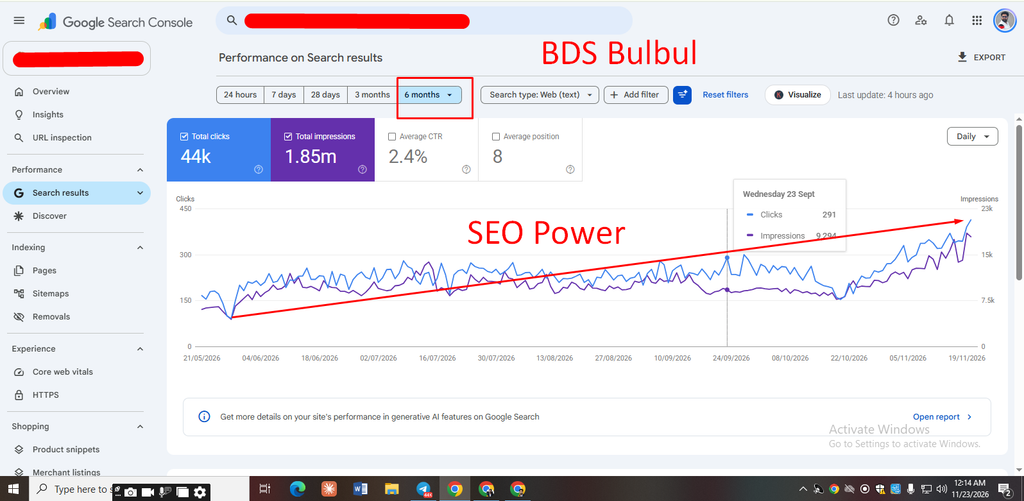
Get Straight to the Point: Combining intent-aligned keywords, clean technical site hygiene, and AI-ready content structure generated 44K organic clicks and 1.85M impressions over a 6-month period. Neither human readers nor modern search engines want drawn-out filler at the top of a page. Our latest Google Search Console (6 months: 21/05/2026 – 19/11/2026) snapshot shows a 2.4% CTR, an 8 average position, and strong upward momentum across clicks and impressions in recent weeks. Verified 6-Month Performance Summary Key metrics from the 6-month Google Search Console report: Performance Metric Verified Result (Last 6 Months) Practical Impact Total Organic Clicks 44k Steady organic visits and buyer clicks to the site Total Impressions 1.85m Broad search visibility across targeted queries Average CTR 2.4% Clear click appeal from titles and snippets Average Position 8 Solid average rank near Page 1 with recent upward momentum The 4 Core Principles Behind This Execution: 1. Direct Answers First (AEO Strategy) Lead key sections with direct, clear answers in the opening lines so readers and AI-driven search features can extract value right away. 2. Real Experience & Trust Signals (E-E-A-T) Ground pages in practical experience, accurate metrics, and clear structure to reinforce credibility and user trust. 3. Scannable Tables & Visual Structure Use structured tables, clear subheadings, and concise points instead of heavy walls of text to keep readers engaged. 4. Owned Audience Channels Beyond Search Build owned touchpoints—such as email newsletters and direct inquiry channels—so your audience isn’t tied solely to search shifts. Next Steps for Your Business Is your website struggling to turn search visibility into steady traffic and leads? A structured SEO and content framework helps brands compete sustainably as search evolves. 👉 I am BDS Bulbul Ahmed (Senior SEO Consultant), ready to help scale your organic search growth. Claim Your FREE SEO Growth Audit! Send us your website URL today to get a Free Audit & Growth Roadmap highlighting key ranking and traffic opportunities.
8.29K+ Clicks & 354K Impressions! A Practical 28-Day Organic Search Growth Case Study
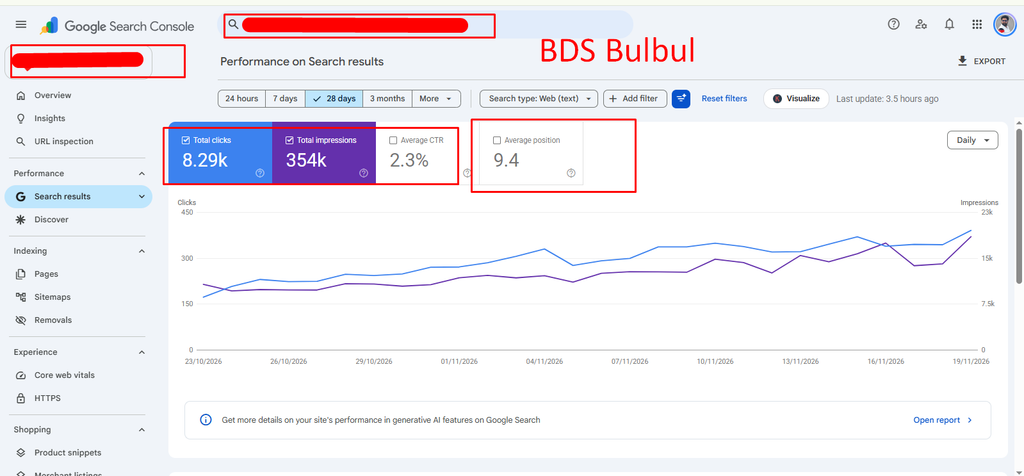
Get Straight to the Point: Combining intent-aligned keywords, clean technical site hygiene, and AI-ready content structure generated 8.29K organic clicks and 354K impressions over a 28-day window. Neither human readers nor modern search engines want drawn-out filler at the top of a page. Our latest Google Search Console (23/10/2026 – 19/11/2026) performance snapshot shows upward momentum across both clicks and impressions alongside a 2.3% CTR and 9.4 average position. Verified Performance Summary (Last 28 Days) Key metrics from the 28-day Google Search Console report: Performance Metric Verified Result (Last 28 Days) Practical Impact Total Organic Clicks 8.29k Steady organic visits and buyer clicks to the site Total Impressions 354k Broad search visibility across targeted queries Average CTR 2.3% Clear click appeal from titles and snippets Average Position 9.4 Consistent upward trend near top search rankings The 4 Core Principles Behind This Execution: 1. Direct Answers First (AEO Strategy) Lead key sections with direct, clear answers in the opening lines so readers and AI-driven search features can extract value right away. 2. Real Experience & Trust Signals (E-E-A-T) Ground pages in practical experience, accurate metrics, and clear structure to reinforce credibility and user trust. 3. Scannable Tables & Visual Structure Use structured tables, clear subheadings, and concise points instead of heavy walls of text to keep readers engaged. 4. Owned Audience Channels Beyond Search Build owned touchpoints—such as email newsletters and direct inquiry channels—so your audience isn’t tied solely to search shifts. Next Steps for Your Business Is your website struggling to turn search visibility into steady traffic and leads? A structured SEO and content framework helps brands compete sustainably as search evolves. 👉 I am BDS Bulbul Ahmed (Senior SEO Consultant), ready to help scale your organic search growth. Claim Your FREE SEO Growth Audit! Send us your website URL today to get a Free Audit & Growth Roadmap highlighting key ranking and traffic opportunities.
The Future of SEO: Who Will Survive the AI Search Era, and Who Won’t
By BDS Bulbul Ahmed | BDS Digital marketing agency | November 20, 2026 Just a few years ago, SEO was simple math. Get onto Google’s first page, and visitors would come. Visitors meant revenue. By 2026, that equation has changed. Google now often answers the question itself, and users leave without ever visiting a website. Many people skip Google entirely and ask ChatGPT or Gemini instead. So is SEO dying? The short answer is no. But SEO is changing, and those who fail to understand that change are the ones who will disappear. Let’s look at the data: what has changed, and what is coming next. At a Glance: The Reality of Search in 2026 Metric Latest data Share of searches showing AI Overviews Rose from 15% to 43% in one year (Similarweb) Zero-click searches (US) 68.01% in the first four months of 2026, up from 60.45% in 2024 Click-through rate for the #1 result when an AI Overview appears About 58% lower (Ahrefs) Google AI Mode users More than 1 billion per month ChatGPT users 1.2 billion per week Publishers’ Google search traffic Down by a third globally between November 2024 and November 2025 From 1950 to 2026: How Search Got Here The philosophical roots of today’s AI search go back to 1950. That year, British mathematician Alan Turing asked in his paper “Computing Machinery and Intelligence” whether machines can think. Roughly seven decades later, that same question sits inside our search bar. The SEO journey, in brief: According to Search Engine Journal, AI Overviews are the biggest change to search since featured snippets were introduced in 2014. The Present: What Has Changed 1. Google now gives answers, not just links AI is no longer an optional add-on to search. According to a new report, Google’s AI Overviews went from appearing in 15% of searches to 43% in just one year. The whole search journey is now built around AI: users are shown an AI Overview first and then invited to continue their research in AI Mode. These numbers vary by methodology, however. SparkToro’s research puts AI Overviews on more than 20% of Google searches, and when they appear, click-through rates drop by nearly 60%. Whichever figure you use, the trend points the same way. 2. Clicks are falling, sharply This is the biggest news for publishers. According to new SparkToro research, 68.01% of Google searches in the US ended without a click during the first four months of 2026, up from 60.45% in 2024. Ahrefs’ research is even more direct: the presence of an AI Overview now correlates with a 58% lower average click-through rate for the top-ranking page. Put simply, for every 100 clicks a top-ranking page used to earn, Google now keeps 58. Publisher traffic reflects this. Chartbeat data published in the Reuters Institute’s 2026 trends report showed that Google search traffic to publishers fell by a third globally between November 2024 and November 2025, and by 38% in the United States. Who is most exposed? Experts point to news, affiliate, recipe and how-to publishers, whose traffic depends heavily on informational searches. 3. Search is happening outside Google, too AI chatbots are now serious competitors to search. OpenAI says ChatGPT grew from 1 billion to 1.2 billion weekly active users in just two months, and that its search volume is roughly 20% of Google’s. Read that number with caution, though: the company has not disclosed its methodology or the source of its Google data, so the 20% should not be read as ChatGPT’s share of the search market. Google isn’t standing still either. The company reports that AI Mode has passed 1 billion monthly active users, and AI Overviews reach 2.5 billion people. 4. Bangla has entered AI search This matters for Bangla-language publishers. In India, Google has expanded AI Mode to seven new languages: Bengali, Kannada, Malayalam, Marathi, Tamil, Telugu and Urdu. Google says the expansion runs on a custom Gemini model for Search, built to understand the nuances of local languages rather than simply translating words. How widely Bangla AI Mode is available in Bangladesh still needs to be checked separately. The message is clear, though: Bangla websites are now competing with AI-generated answers as well. What Google Itself Is Saying A whole industry has sprung up selling AI search tactics under names like “AEO” (Answer Engine Optimization) and “GEO” (Generative Engine Optimization). In May 2026, Google addressed this directly by publishing its first official guide to AI search optimization on May 15. The guide includes: What does “non-commodity content” mean? Google explicitly prioritizes content that goes beyond what anyone with a search engine could produce. The guidance gives a clear example: a summary of existing advice is commodity content. An article stitched together from ten other websites is something AI can generate on its own, and readers then have no reason to visit your site. Google’s position on popular “GEO tactics”: According to Google, llms.txt files, content chunking, AI-specific rewriting and special schema are not needed to appear in its generative AI features. Google’s documentation states plainly that while terms like AEO and GEO are common online, many of the suggested “hacks” aren’t effective or supported by how Google Search actually works. Liz Reid, the head of Google Search, has also cautioned businesses. She urged them to develop a clear niche, publish content that goes beyond basic AI summaries, and question vendors who promise a guaranteed formula for generative engine optimization. What the 2026 Core Updates Taught Us This year brought two major core updates: the March 2026 core update began on March 27, and the May 2026 core update on May 21. The March update was unprecedented in its volatility; according to SE Ranking, it moved 79.5% of top-3 positions, the most volatile update measured to date. One misconception about E-E-A-T needs clearing up. E-E-A-T is not itself a ranking factor; it is Google’s quality framework for the human raters who help train the algorithm. Its influence has spread everywhere, though.
The Future of SEO: Who Will Survive the AI Search Era, and Who Won’t
By BDS Bulbul Ahmed |BDS Digital Marketing agency | November 20, 2026 Just a few years ago, SEO was simple math. Get onto Google’s first page, and visitors would come. Visitors meant revenue. By 2026, that equation has changed. Google now often answers the question itself, and users leave without ever visiting a website. Many people skip Google entirely and ask ChatGPT or Gemini instead. So is SEO dying? The short answer is no. But SEO is changing, and those who fail to understand that change are the ones who will disappear. Let’s look at the data: what has changed, and what is coming next. At a Glance: The Reality of Search in 2026 Metric Latest data Share of searches showing AI Overviews Rose from 15% to 43% in one year (Similarweb) Zero-click searches (US) 68.01% in the first four months of 2026, up from 60.45% in 2024 Click-through rate for the #1 result when an AI Overview appears About 58% lower (Ahrefs) Google AI Mode users More than 1 billion per month ChatGPT users 1.2 billion per week Publishers’ Google search traffic Down by a third globally between November 2024 and November 2025 From 1950 to 2026: How Search Got Here The philosophical roots of today’s AI search go back to 1950. That year, British mathematician Alan Turing asked in his paper “Computing Machinery and Intelligence” whether machines can think. Roughly seven decades later, that same question sits inside our search bar. The SEO journey, in brief: According to Search Engine Journal, AI Overviews are the biggest change to search since featured snippets were introduced in 2014. The Present: What Has Changed 1. Google now gives answers, not just links AI is no longer an optional add-on to search. According to a new report, Google’s AI Overviews went from appearing in 15% of searches to 43% in just one year. The whole search journey is now built around AI: users are shown an AI Overview first and then invited to continue their research in AI Mode. These numbers vary by methodology, however. SparkToro’s research puts AI Overviews on more than 20% of Google searches, and when they appear, click-through rates drop by nearly 60%. Whichever figure you use, the trend points the same way. 2. Clicks are falling, sharply This is the biggest news for publishers. According to new SparkToro research, 68.01% of Google searches in the US ended without a click during the first four months of 2026, up from 60.45% in 2024. Ahrefs’ research is even more direct: the presence of an AI Overview now correlates with a 58% lower average click-through rate for the top-ranking page. Put simply, for every 100 clicks a top-ranking page used to earn, Google now keeps 58. Publisher traffic reflects this. Chartbeat data published in the Reuters Institute’s 2026 trends report showed that Google search traffic to publishers fell by a third globally between November 2024 and November 2025, and by 38% in the United States. Who is most exposed? Experts point to news, affiliate, recipe and how-to publishers, whose traffic depends heavily on informational searches. 3. Search is happening outside Google, too AI chatbots are now serious competitors to search. OpenAI says ChatGPT grew from 1 billion to 1.2 billion weekly active users in just two months, and that its search volume is roughly 20% of Google’s. Read that number with caution, though: the company has not disclosed its methodology or the source of its Google data, so the 20% should not be read as ChatGPT’s share of the search market. Google isn’t standing still either. The company reports that AI Mode has passed 1 billion monthly active users, and AI Overviews reach 2.5 billion people. 4. Bangla has entered AI search This matters for Bangla-language publishers. In India, Google has expanded AI Mode to seven new languages: Bengali, Kannada, Malayalam, Marathi, Tamil, Telugu and Urdu. Google says the expansion runs on a custom Gemini model for Search, built to understand the nuances of local languages rather than simply translating words. How widely Bangla AI Mode is available in Bangladesh still needs to be checked separately. The message is clear, though: Bangla websites are now competing with AI-generated answers as well. What Google Itself Is Saying A whole industry has sprung up selling AI search tactics under names like “AEO” (Answer Engine Optimization) and “GEO” (Generative Engine Optimization). In May 2026, Google addressed this directly by publishing its first official guide to AI search optimization on May 15. The guide includes: What does “non-commodity content” mean? Google explicitly prioritizes content that goes beyond what anyone with a search engine could produce. The guidance gives a clear example: a summary of existing advice is commodity content. An article stitched together from ten other websites is something AI can generate on its own, and readers then have no reason to visit your site. Google’s position on popular “GEO tactics”: According to Google, llms.txt files, content chunking, AI-specific rewriting and special schema are not needed to appear in its generative AI features. Google’s documentation states plainly that while terms like AEO and GEO are common online, many of the suggested “hacks” aren’t effective or supported by how Google Search actually works. Liz Reid, the head of Google Search, has also cautioned businesses. She urged them to develop a clear niche, publish content that goes beyond basic AI summaries, and question vendors who promise a guaranteed formula for generative engine optimization. What the 2026 Core Updates Taught Us This year brought two major core updates: the March 2026 core update began on March 27, and the May 2026 core update on May 21. The March update was unprecedented in its volatility; according to SE Ranking, it moved 79.5% of top-3 positions, the most volatile update measured to date. One misconception about E-E-A-T needs clearing up. E-E-A-T is not itself a ranking factor; it is Google’s quality framework for the human raters who help train the algorithm. Its influence has spread everywhere, though. E-E-A-T
6.34K+ Clicks & 234K Impressions! A Practical Guide to Scaling Organic Search Growth in the AI Era
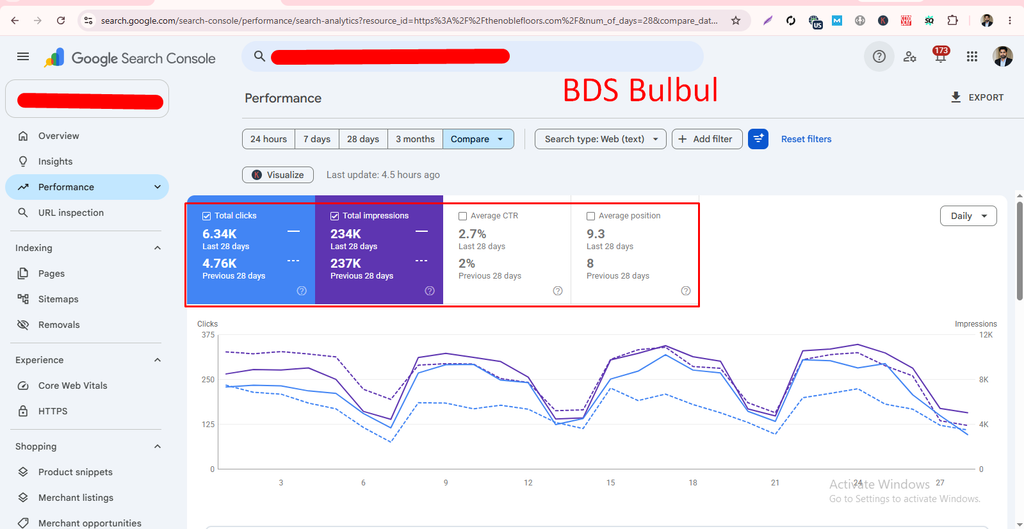
Get Straight to the Point: In the modern era of AI and advanced search engines, neither readers nor algorithms appreciate fluff. To succeed in SEO, your core answer must be delivered within the first three lines so that search snippets feature your content directly. Core Challenges & Our Modern SEO Frameworks To stay ahead of search engine volatility, modern content strategies rely on 4 golden rules: Verified Performance Summary (Last 28 Days) Review our comparative Google Search Console performance metrics below: Performance Metric Current Period (Last 28 Days) Previous Period Growth & Impact Screenshot_4.png Total Organic Clicks 6.34K 4.76K Massive high-intent buyer traffic growth Total Impressions 234K 237K High-converting targeted search visibility Average CTR 2.7% 2% Enhanced click-through engagement Average Position 9.3 8 Stable Page 1 positioning and traffic scaling Conclusion & Next Steps for Your Brand Is your website struggling to maintain steady traffic amidst shifting search algorithms? Sustainable long-term growth requires an expert, algorithm-proof search roadmap. I am BDS Bulbul Ahmed (Senior SEO Consultant with 6+ Years of Experience & 250+ Successful Projects), ready to scale your organic search revenue and brand authority. Get Your FREE SEO & Growth Audit Today! Send us your website URL to receive a comprehensive Free Audit & Growth Roadmap identifying your exact ranking bottlenecks.
Elementor #3200
Home Team BDS Bulbul Ahmed ★6+ yrsSEO experience ✓250+Projects led Available for new projects CEO & Founder · Senior SEO Consultant BDS Bulbul Ahmed SEO & digital marketing strategist and founder of BDS Digital Marketing Agency. For 6+ years he has helped brands in Bangladesh, the USA, the UAE and the UK turn search visibility into customers and revenue. Talk to Bulbul → Connect on LinkedIn 6+Years in SEO & digital marketing 250+Projects led 15+Industries served 8+In-house specialists led Who is BDS Bulbul Ahmed? BDS Bulbul Ahmed is the CEO and founder of BDS Digital Marketing Agency, based in Uttara, Dhaka, Bangladesh. He is a senior SEO consultant and digital marketing strategist with 6+ years of experience who has led 250+ projects across 15+ industries — building custom organic-search strategies and web solutions for brands in Bangladesh, the USA, the UAE and the UK. Book a free strategy call with Bulbul → Quick facts Role: CEO & Founder, Senior SEO Consultant Company: BDS Digital Marketing Agency Based in: Uttara, Dhaka, Bangladesh Experience: 6+ years in SEO & digital marketing Work: 250+ projects led across 15+ industries Markets: Bangladesh, USA, UAE (Dubai) & UK (London) Languages: English & Bengali Philosophy “Rankings are a means, not the goal.” For Bulbul, SEO only matters when it brings in customers. Every strategy he builds starts with a business goal — leads, sales or bookings — and works backwards to the keywords, content and links that will deliver it. As he puts it: “We measure success by customers, revenue and momentum — not vanity metrics.” Areas of expertise What does Bulbul Ahmed specialize in? Hands-on SEO expertise, backed by a full in-house team for ads, web, content and design. SEO Strategy Keyword research, topical authority and growth roadmaps. Technical SEO Site speed, indexing, Core Web Vitals and schema. Local SEO Google Business Profile and Google Maps ranking. Link Building White-hat authority building and digital PR. E-commerce SEO Category, product and store SEO that drives sales. AI Search (AEO & GEO) Getting brands cited in AI Overviews and ChatGPT. Paid Media Strategy Google and Meta campaigns aligned with SEO. Content Strategy Content that ranks, answers questions and converts. How he works The principles behind every campaign “Behind every campaign is a data-backed strategy designed to deliver real, lasting results.” 1 Built on integrity Transparent reporting, honest timelines and no jargon used to hide thin results. 2 Measured by results Optimizing for revenue and ROI — not impressions or vanity rankings. 3 Powered by people Every client is treated as a teammate, with a clear point of contact. 4 White-hat, long-term SEO Methods that follow Google’s guidelines and survive core updates. Where he works Markets Bulbul Ahmed serves Through BDS Digital Marketing Agency, Bulbul leads SEO and digital marketing for businesses in four markets. 🇧🇩 Bangladesh Home base in Uttara, Dhaka. 🇺🇸 United States SEO and PPC for US brands. 🇦🇪 Dubai & UAE SEO agency in Dubai. Dubai SEO → 🇬🇧 London & UK SEO agency in London. London SEO → Written & reviewed Guides and pages reviewed by Bulbul Ahmed SEO Agency in Dubai Local SEO Dubai: Rank in the Google Maps Top 3 Digital Marketing Agency in Dubai SEO Agency in London Local SEO London: Rank in the Google Maps Top 3 Digital Marketing Agency in London FAQ Questions about Bulbul Ahmed Who is BDS Bulbul Ahmed? BDS Bulbul Ahmed is the CEO and founder of BDS Digital Marketing Agency, based in Uttara, Dhaka, Bangladesh. He is a senior SEO consultant and digital marketing strategist with 6+ years of experience who has led 250+ projects across 15+ industries for clients in Bangladesh, the USA, the UAE and the UK. What does BDS Bulbul Ahmed specialize in? He specializes in SEO strategy, technical SEO, local SEO, link building, e-commerce SEO and AI search optimization (AEO and GEO), and leads the agency’s paid media, content and web teams. How can I contact BDS Bulbul Ahmed? You can reach him through WhatsApp at +880 1829-349380, on LinkedIn, or through the contact page. Does BDS Bulbul Ahmed work with clients outside Bangladesh? Yes. Through BDS Digital Marketing Agency he works with businesses in the USA, Dubai and the wider UAE, and London and the wider UK, as well as Bangladesh. Want Bulbul to look at your SEO? Book a free strategy call and get an honest view of where your website stands and what will move it forward. Chat on WhatsApp →
12.3K Clicks & 554K Impressions in 3 Months
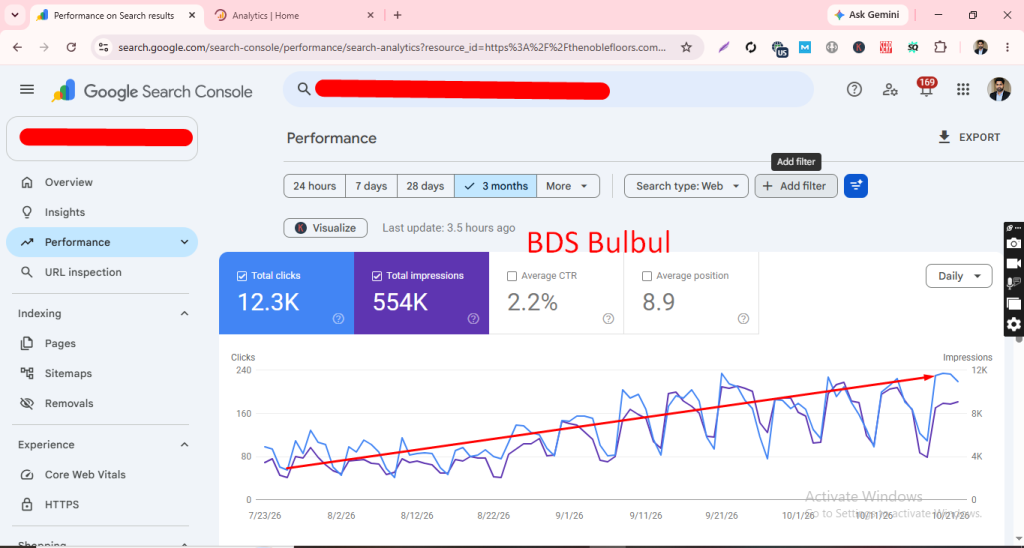
12.3K Clicks and 554K Impressions in 3 Months: A Client Website Search Console Case Study In SEO, data is the real proof, and it is far more credible than any agency’s claims. In this article, we walk through the actual Google Search Console performance report of one of our client websites, what happened over the last 3 months, and what these numbers mean for your business. (The client’s website name is not disclosed to protect their privacy.) Quick Summary (3-Month Results) Period: July 23, 2026 to October 21, 2026 (Search type: Web) Metric Result Total Clicks 12.3K Total Impressions 554K Average CTR 2.2% Average Position 8.9 What Does the Graph Tell Us? The Performance graph shows a clear upward trend. In late July, daily clicks were roughly around 80, and impressions were around 4K. By the third week of October, daily clicks had climbed above 200 and impressions reached about 12K. Based on the graph, clicks grew roughly 2.5 times and impressions roughly 3 times. Both clicks and impressions grew together. This is a healthy sign, because it means Google is showing your pages in more searches, and people are clicking through. How to Read Each Metric 1. Total Impressions (554K): Your pages appeared in Google search results this many times. This is visibility, not visitors. Growing impressions mean you are showing up for more keywords in front of more people. 2. Total Clicks (12.3K): People came to your site from search this many times. For a business, this is the most useful number, because leads and sales come from clicks. 3. Average CTR (2.2%): About 2.2 clicks for every 100 impressions. We still see this as room for improvement. Better titles and meta descriptions can earn more clicks from the same impressions. 4. Average Position (8.9): On average, the site sits near the bottom of page one. A position of 8.9 means many keywords are on the first page while some pages are on the second. In other words, there is still room to climb. One Important Point to Remember Average position in Search Console is an average. Every keyword has its own position, and no agency can guarantee a specific ranking by a specific date. Consistent upward movement in the data is the real sign of progress. In this case study too, you will notice weekly ups and downs in the graph (traffic dips on weekends), but the overall trend is upward. What Usually Drives Consistent SEO Growth Content matched to search intent: Structuring pages around what people are actually looking for. See our On-Page SEO service. Technical health: Keeping indexing, site speed and Core Web Vitals in good shape. See our Technical SEO service. Keyword research: Finding low-competition, high-intent keywords. See our Keyword Research service. Building trust: Quality backlinks and brand signals. See our SEO Link Building service. Ongoing monitoring: Reviewing Search Console weekly to spot which pages are performing and which are falling behind. What Does This Mean for You? If your Search Console shows impressions growing but clicks not following, or the graph is flat, an audit can pinpoint the problem. We analyze your site and build a prioritized action plan. Frequently Asked Questions (FAQ) What is the difference between impressions and clicks in Search Console? Impressions are the number of times your page appeared in search results, and clicks are the number of times people visited your site from those results. Is a 2.2% CTR good? CTR depends on the industry, keyword type and position. Instead of judging from a single number, look at the trend over time and page-level CTR. How long does SEO take to show results? It depends on competition and the site’s current condition. SEO is generally a long-term process, so consistency matters most. Does an average position of 8.9 mean all keywords are on page one? No. It is an average across all keywords. Some rank higher and some lower. Ready to Grow Your Website’s SEO? We offer free consultations. Contact us on WhatsApp or visit our SEO Services page. Author: Bulbul Ahmed, Senior SEO Consultant, BDS Digital Marketing Agency
A Client Website Search Console Case Study
In SEO, data is the real proof, and it is far more credible than any agency’s claims. In this article, we walk through the actual Google Search Console performance report of one of our client websites, what happened over the last 3 months, and what these numbers mean for your business. (The client’s website name is not disclosed to protect their privacy.) Quick Summary (3-Month Results) Period: July 23, 2026 to October 21, 2026 (Search type: Web) Metric Result Total Clicks 12.3K Total Impressions 554K Average CTR 2.2% Average Position 8.9 What Does the Graph Tell Us? The Performance graph shows a clear upward trend. In late July, daily clicks were roughly around 80, and impressions were around 4K. By the third week of October, daily clicks had climbed above 200 and impressions reached about 12K. Based on the graph, clicks grew roughly 2.5 times and impressions roughly 3 times. Both clicks and impressions grew together. This is a healthy sign, because it means Google is showing your pages in more searches, and people are clicking through. How to Read Each Metric 1. Total Impressions (554K): Your pages appeared in Google search results this many times. This is visibility, not visitors. Growing impressions mean you are showing up for more keywords in front of more people. 2. Total Clicks (12.3K): People came to your site from search this many times. For a business, this is the most useful number, because leads and sales come from clicks. 3. Average CTR (2.2%): About 2.2 clicks for every 100 impressions. We still see this as room for improvement. Better titles and meta descriptions can earn more clicks from the same impressions. 4. Average Position (8.9): On average, the site sits near the bottom of page one. A position of 8.9 means many keywords are on the first page while some pages are on the second. In other words, there is still room to climb. One Important Point to Remember Average position in Search Console is an average. Every keyword has its own position, and no agency can guarantee a specific ranking by a specific date. Consistent upward movement in the data is the real sign of progress. In this case study too, you will notice weekly ups and downs in the graph (traffic dips on weekends), but the overall trend is upward. What Usually Drives Consistent SEO Growth Content matched to search intent: Structuring pages around what people are actually looking for. See our On-Page SEO service. Technical health: Keeping indexing, site speed and Core Web Vitals in good shape. See our Technical SEO service. Keyword research: Finding low-competition, high-intent keywords. See our Keyword Research service. Building trust: Quality backlinks and brand signals. See our SEO Link Building service. Ongoing monitoring: Reviewing Search Console weekly to spot which pages are performing and which are falling behind. What Does This Mean for You? If your Search Console shows impressions growing but clicks not following, or the graph is flat, an audit can pinpoint the problem. We analyze your site and build a prioritized action plan. Frequently Asked Questions (FAQ) What is the difference between impressions and clicks in Search Console? Impressions are the number of times your page appeared in search results, and clicks are the number of times people visited your site from those results. Is a 2.2% CTR good? CTR depends on the industry, keyword type and position. Instead of judging from a single number, look at the trend over time and page-level CTR. How long does SEO take to show results? It depends on competition and the site’s current condition. SEO is generally a long-term process, so consistency matters most. Does an average position of 8.9 mean all keywords are on page one? No. It is an average across all keywords. Some rank higher and some lower. Ready to Grow Your Website’s SEO? We offer free consultations. Contact us on WhatsApp or visit our SEO Services page. Author: Bulbul Ahmed, Senior SEO Consultant, BDS Digital Marketing Agency